
What If My Work Injury Symptoms Did Not Show Up Until Days or Weeks Later in Georgia?
Not every work injury announces itself. You lift something wrong on Monday and feel fine. By Thursday your back is locking up and you can barely get out of bed. Or the aching in your wrist that you brushed off for weeks turns out to be real damage from doing the same motion all day, every day.
Then the worry creeps in. It has been a while now. Did I wait too long? Do I even have a claim anymore?
You might have a strong claim. But in Georgia the clock is not your friend, and the insurance company is quietly counting on you to run it out. I want to explain the rules in plain English, and then tell you exactly what to do today.
Delayed and gradual injuries are real, and they are common
First, let go of the idea that a real work injury has to be one dramatic accident. National workplace safety data tells a very different story about how people actually get hurt on the job.
According to the U.S. Bureau of Labor Statistics, overexertion and repetitive motion, the kind of injury that builds up over time, is the single leading cause of serious work injuries:
| What the national data shows (BLS, 2023 to 2024) | Figure |
|---|---|
| Leading cause of days-away-from-work cases | Overexertion, repetitive motion, and bodily reaction |
| Cases from that leading cause (two-year period) | About 946,000 |
| Total nonfatal workplace injuries and illnesses, 2024 | About 2.5 million |
| Median time away from work | 8 days |
The National Safety Council reports the same pattern: overexertion and repetitive motion injuries are among the most common workplace injuries year after year. And the CDC workplace safety institute, NIOSH, treats work-related musculoskeletal disorders, the sprains, strains, and back and joint injuries that often develop gradually, as one of the most common and costly categories of on-the-job harm.
Translation: an injury that did not hurt the second it happened, or that came from repetition instead of one bad moment, is not unusual and does not automatically kill your claim. It also does not matter that you were not in perfect health beforehand, since workers’ compensation and pre-existing conditions can still go together. What can kill a claim is waiting too long to report.
The 30-day rule you cannot ignore
Here is the deadline that trips up the most workers.
In Georgia, you are generally required to report your work injury to your employer within 30 days (O.C.G.A. section 34-9-80). The safest way to read that is 30 days from the injury, or from when you knew, or reasonably should have known, that your work caused it.
Miss that window, and the insurer has an easy reason to deny you. I saw this play out from the defense side more times than I can count. A worker with a real, legitimate injury loses the claim on a technicality, because nobody ever told them about the 30-day rule. The injury was real. The denial was avoidable.
So the move is simple. Report it in writing now, even if you are not sure yet how bad it is. Tell your supervisor. Put it in writing. Keep a dated copy for yourself. Our list of 13 things not to do when injured on the job covers the other early mistakes worth avoiding.
Reporting and filing are two different deadlines
People mix these up, so let us separate them clearly.
- Reporting is telling your employer about the injury. That is the 30-day deadline above.
- Filing a claim with the State Board of Workers’ Compensation is a separate step with its own longer deadline. In general, a claim must be filed within one year of the injury, though authorized medical treatment or payment of benefits can affect that timeline (O.C.G.A. section 34-9-82). The claim is filed on a form called the WC-14.
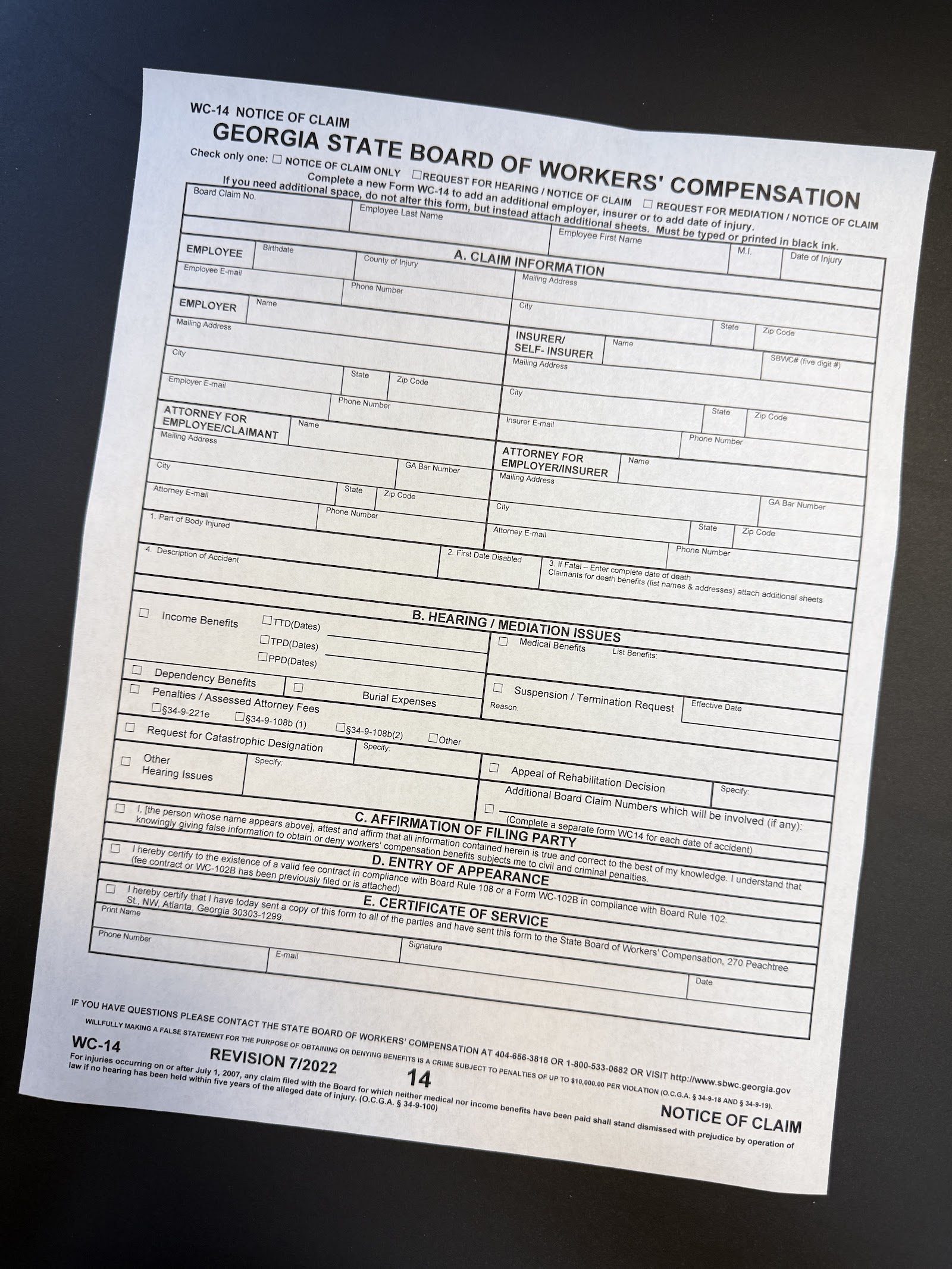
Both clocks matter, and delayed-onset injuries are exactly the situation where the timing gets tricky. Our full breakdown of the Georgia injury and workers’ comp deadlines lays out every deadline side by side. Deadlines also have exceptions that turn on your specific facts, so if you are close to one or already past it, that is a reason to call a lawyer today, not a reason to give up.
Why I did not want to make a big deal of it backfires
A lot of good, hard-working people stay quiet. You do not want to look like a complainer. You figure it will heal on its own. You need the shifts, and you do not want trouble with the boss. Sometimes the boss even says, do not worry, we will take care of you, so you never report it. If that sounds familiar, read hurt at work but told not to file in Georgia.
I understand all of that, and I do not judge anyone for it. But here is what the insurance company sees when you wait. A gap between the injury and the report is the first thing they use to argue your injury did not happen at work, or did not happen when you say it did. Every week of silence is another week they can point to, and it makes things easier for them if your employer resists the claim.
Reporting early is not making a big deal out of nothing. It is protecting yourself. You can report an injury and still be a great employee. The two are not in conflict.
What to do right now
- Report the injury to your employer in writing today, even if the symptoms are still mild.
- Write down what happened, when it started, and what work caused it.
- See a doctor and tell them it is work related, so it is in the medical record.
- Keep dated copies of everything.
- If you are unsure about a deadline, ask a lawyer before assuming it is too late.
For how the rest of the process works, read our overview of Georgia workers’ compensation. If your claim already got denied over timing, our guide on the five steps to fight a denied workers’ comp claim is the place to start, and you can learn about Rick DeMedeiros and how the insider view helps fight those denials.
You handle healing. Let us handle the insurance company. If your work injury showed up late, do not wait any longer to protect it. Request your free consultation. Se habla español.
Sources
- U.S. Bureau of Labor Statistics, Employer-Reported Workplace Injuries and Illnesses, 2023 to 2024.
- National Safety Council, Injury Facts, Overexertion and Bodily Reaction.
- National Institute for Occupational Safety and Health (NIOSH), CDC, on work-related musculoskeletal disorders.
- O.C.G.A. section 34-9-80, Notice of Injury (30-day reporting requirement).
- O.C.G.A. section 34-9-82, Time Limitations for Filing Claims.
Attorney advertising. This article is general information about Georgia law and is not legal advice. Deadlines have exceptions and depend on your specific facts. Reading this does not create an attorney-client relationship, and it is not a substitute for advice from a licensed Georgia attorney about your situation. Prior results do not guarantee a similar outcome. Responsible attorney: Rick J. DeMedeiros, The Law Office of Rick J. DeMedeiros, P.C., Alpharetta, GA.