
Your Georgia Workers’ Comp Claim Got Denied. Here’s Exactly What I’d Do Next.
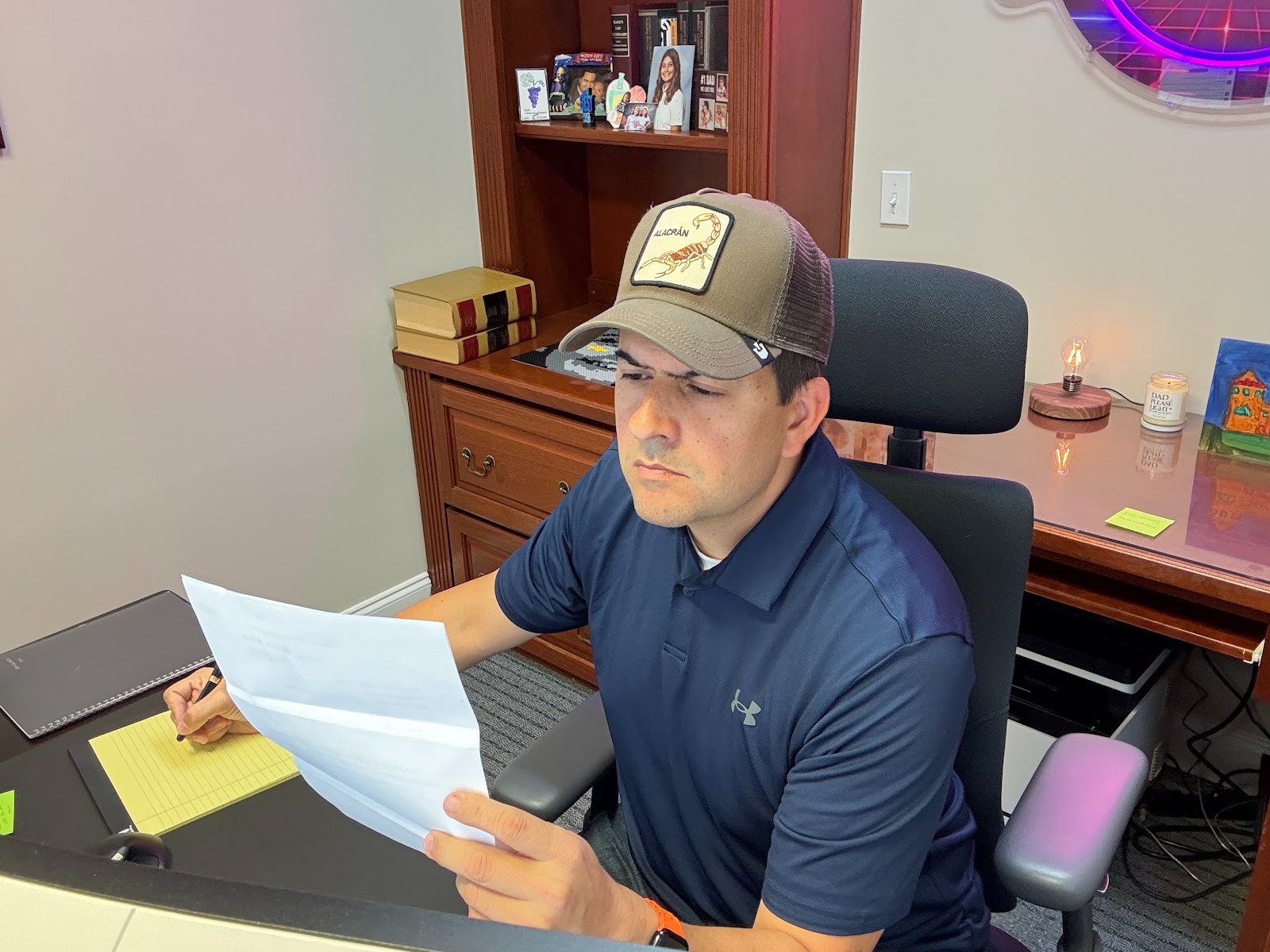
If your workers’ comp claim was denied in Georgia, a denial letter is built to make you give up. That is its whole job.
I spent the first five years of my career on the other side of these cases, defending insurance companies and employers in Georgia workers’ comp claims. I saw how denials get written, why they get sent, and how often they fall apart the moment somebody pushes back. So when you open that letter and your stomach drops, hear this from someone who used to write them: a denial is not a verdict. In Georgia, it is usually the start of the fight, not the end of it.
Let me walk you through what just happened and what I would do if I were sitting across the desk from you.
Why your claim got denied (it’s rarely about whether you got hurt)
When your workers’ comp claim is denied in Georgia, people assume a denial means the insurance company decided they are faking. Almost never. The denial is usually about a technicality the insurer can hang a ‘no’ on. The common ones I see:
- You reported the injury late, or there’s no record you reported it at all.
- They claim the injury did not happen at work, or did not happen the way you said.
- They blame a “pre-existing condition,” as if your back problem started on its own the same week you lifted something at work.
- Paperwork is missing or filled out wrong.
- Their doctor disagrees with your doctor about how hurt you are.
Here is the part most people never hear: insurers deny first and sort it out later because a predictable share of injured workers never push back. I watched it work from the inside. The denial is a filter. The people who respond correctly tend to recover. The people who fold tend to get nothing.
A denial is not a verdict. It’s a starting position.
First, read the letter. Then watch the calendar.
Your denial usually comes as a form (often called a WC-3 or a Notice to Controvert). It tells you exactly what the insurer is disputing. Read it, because that’s the argument you have to answer.
Then look at two clocks, because Georgia has two that matter. You generally must report your injury to your employer within 30 days, and you generally have one year from the date of injury to file your claim with the State Board of Workers’ Compensation (O.C.G.A. § 34-9-82). If your benefits were being paid and then got cut off, different reopening clocks apply. Either way, the calendar is not your friend after a denial.
For what it’s worth, the insurer has its own deadline, too: 21 days to investigate and report after they’re notified. They are on a clock as much as you are.
How you actually fight a workers’ comp claim denied in Georgia
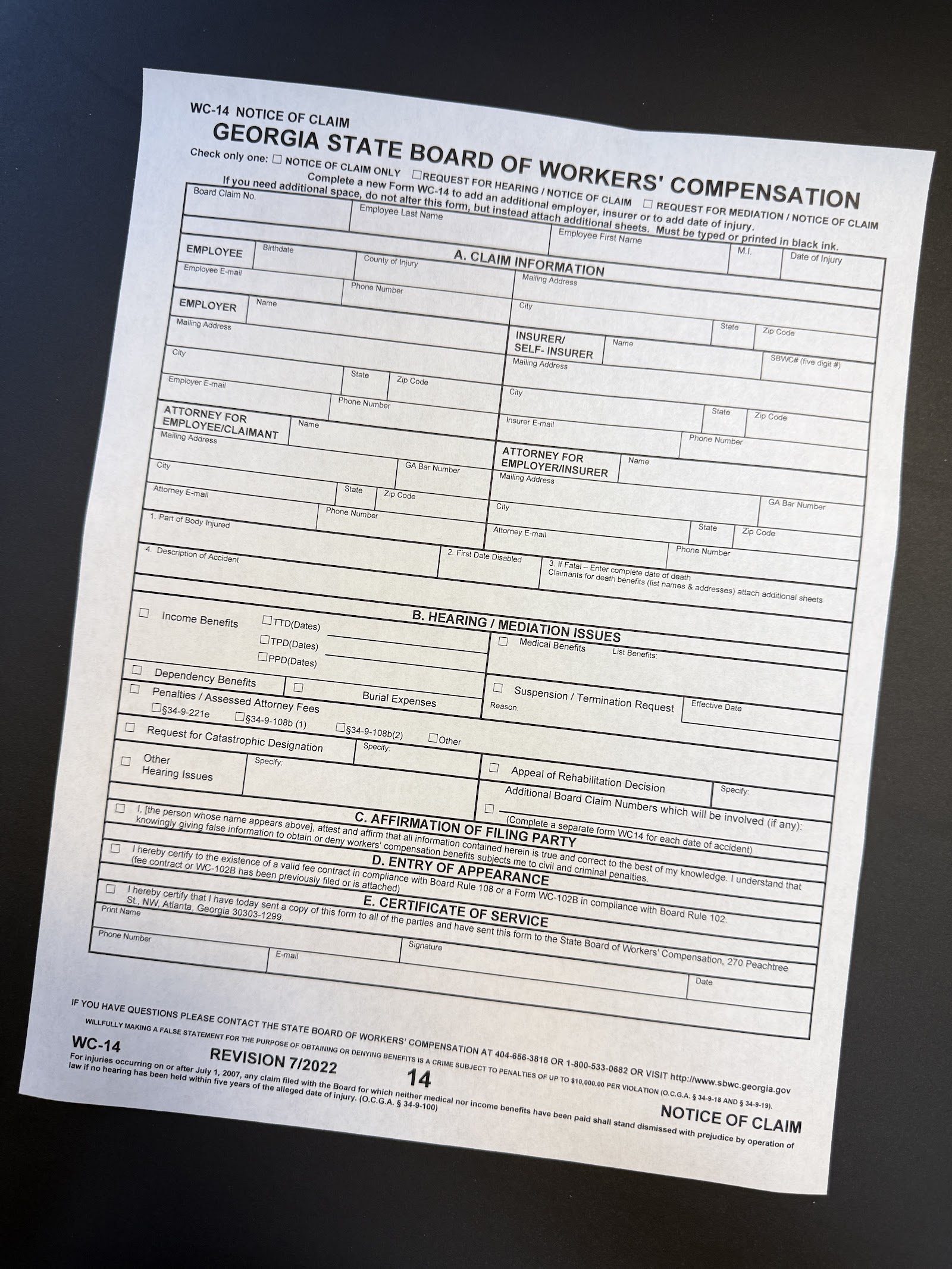
The move that reopens everything is one form: Form WC-14, filed with the State Board of Workers’ Compensation, requesting a hearing. Here’s the sequence:
- File the WC-14 with the State Board and send copies to your employer and its insurance carrier.
- You will get a hearing date in front of an Administrative Law Judge, usually scheduled within about 60 days, in the county where you were hurt. However, keep in mind that first settings always get postponed at least once.
- About another 30 days after the hearing, the judge issues a written decision.
- If the judge rules against you, you have 20 days to appeal to the Appellate Division of the State Board.
None of this requires you to be a lawyer. But every step has rules, and the insurer’s attorneys do this for a living. That’s the gap a good comp lawyer closes. Plus, these are just general steps. I have left out a lot of nuance and there are always exceptions and loopholes to everything, so be careful if you decide to pursue a case on your own. I don’t recommend it.
What’s actually on the line (the real numbers)
This is why insurers fight so hard. In Georgia, wage benefits for being unable to work (temporary total disability) are two-thirds of your average weekly wage, capped at $800 per week for injuries on or after July 1, 2023, and they can run up to 400 weeks. Add medical treatment, mileage to appointments, and money for permanent disability, and the value of a single claim climbs fast.
Every case is different, but I have recovered $795,000 for a worker who fell onto concrete and needed multiple surgeries, $650,000 for a man who fell from a lift and needed a spinal cord stimulator, and $300,000 for a roofer with back herniations. I am not telling you that to brag, and I am not promising you a number. Every case turns on its own facts. I am telling you so you understand why the insurance company would rather send a denial letter than write those checks. And don’t be surprised if an adjuster then calls you pretending to be doing you a favor by offering you $5,000 to settle your denied claim. It’s a trap!
The first 72 hours: what I’d do right now
The days right after a workers’ comp claim is denied in Georgia matter more than people realize. Do nothing and the insurer’s position hardens while your clock keeps running. Here’s the short list I give people who call me the day the letter arrives.
- Get copies of everything. Your denial letter, the incident report, and your medical records so far. You can’t fight an argument you can’t see.
- Keep treating. Gaps in medical treatment are the first thing an insurer points to. If you stop going, they’ll say you got better.
- Write down what happened while it’s fresh. Date, time, what you were doing, and who saw it. Memory fades fast under stress.
- Don’t give a recorded statement or sign a release without advice. Those are the tools they use to shrink or close your claim.
- Talk to a workers’ comp lawyer before the one-year window gets close. The earlier someone is tracking the deadline, the more options you keep.
The mistakes that turn a fixable denial into a lost claim
Most cases where a workers’ comp claim is denied in Georgia are survivable. What usually sinks a claim isn’t the denial itself, it’s what the worker does next. I see the same handful of avoidable mistakes over and over.
Skipping medical appointments hands the insurer an easy argument that you’re fine. Keep in mind that you may have to use your health insurance temporarily. Posting photos of yourself doing yard work or lifting your kids gives them video to play at your hearing, even if you paid for it with three days in bed. Quitting your job in frustration can complicate your wage benefits. And the most common one of all, waiting to see if it gets better on its own, simply burns the clock. A denial is a problem you can fix. Silence usually isn’t.
Why people who fight a denial with a lawyer tend to do better
I know the defense playbook because I ran it. When I read a denial now, I can usually see which argument they’re setting up and what evidence knocks it down. If you want help, our Georgia workers’ compensation overview lays out how the system works, our workers’ comp case results show what’s possible, and you can schedule a free consultation any time, 24/7. It also helps to understand the Georgia injury and workers’ comp deadlines and what to do if you were hurt at work but told not to file.
You pay nothing up front. There’s no fee unless we recover money for you. And if it’s easier to tell me what happened in Spanish, yo hablo español, so say the word.
Frequently asked questions
Related reading on Georgia injury & workers’ comp
- What to do if you were hurt at work but told “don’t file” or “you’re a contractor”
- The deadlines that can make or break your Georgia injury or workers’ comp claim
- How impairment ratings work in Georgia workers’ comp — and why they matter
Recognized in the community
Beyond the courtroom, Rick DeMedeiros is known as “The Work Comp Guy” on YouTube, where he has published dozens of plain-English videos helping injured Georgians understand their rights. His client-education work was recently featured by digital-marketing educator Dennis Yu at the DigiMarCon conference as an example of an attorney using honest, helpful content to serve his community rather than chase clicks.
About the Author
Rick J. DeMedeiros, Esq. is the founder of DeMedeiros Injury Law (The Law Office of Rick J. DeMedeiros, P.C.) in Alpharetta, Georgia. He earned both his B.B.A. and his J.D., magna cum laude, from Georgia State University and was admitted to the State Bar of Georgia in 2004.
For the first five years of his career he defended employers and insurance companies in workers’ compensation cases. In 2009 he switched sides to represent injured Georgia workers and accident victims, using what he learned on the defense side to fight for his clients.
He is a certified neutral and registered workers’ compensation mediator, rated AV Preeminent by Martindale-Hubbell, and named to the Georgia Super Lawyers list (Workers’ Compensation, Claimant) every year from 2020 through 2026. He is fluent in English and Spanish. Call (678) 996-5050. Se habla español.
Legally reviewed by Rick J. DeMedeiros, Esq., before publication.
Sources
- Georgia State Board of Workers’ Compensation (official)
- File a Workers’ Compensation Claim — Georgia.gov
- O.C.G.A. Title 34, Chapter 9 (Workers’ Compensation) — Justia
Disclaimer: This article is general information about Georgia law and is not legal advice. Reading it does not create an attorney-client relationship. Deadlines, benefit amounts, and rules change and depend on the specific facts of your case. For advice about your situation, speak with a licensed Georgia attorney. Prior case results do not guarantee a similar outcome.